
Downtown Façade Improvement Program
The City of Ellsworth is accepting applications for the Downtown Façade Improvement Grant Program. This program is intended to assist with projects that improve or rehabilitate commercial building exteriors to their original character or make ADA improvements in conjunction with entrance improvements. The program is available to property owners and/or tenants (with the property owner’s permission) in the grant area for buildings that are at least 50 years old. All proposed projects undergo consultation review by the Maine Historic Preservation Commission and are required to follow the City’s building ordinance.
This grant cannot be used for work that has already been started or has already been completed.
The Downtown Façade Improvement Program advisory committee will review applications and make award decisions.
Do you have questions about a potential project? Want to learn more? Let’s talk! Reach out to the Program Administrators who are available to answer your questions and guide you through this process.
The application period is now closed.
Program Administrators
Brittany Merrill
Planning and Community Development Assistant
Twila Fisher
Economic Development Director
Email us at:
Program Guidelines
Read and review the guide below prior to submitting an application.
Ellsworth Downtown Façade Improvement Program Guidelines
Review the map of the program area:
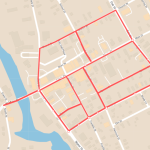
Click to enlarge.
FREQUENTLY ASKED QUESTIONS (FAQs)
What is a façade?
A facade is considered the front (or face) of a building facing a street. For the purpose of this program where buildings have frontage on two streets, the facade will be the portions of the building readily viewed from either street at street level.
What is the CDBG façade program?
The Community Development Block Grant (CDBG) program, administered by the U.S. Department of Housing and Urban Development (HUD), provides annual grants to cities, counties, and states to support community development initiatives.
In Ellsworth, CDBG funds support programs like the Downtown Facade Improvement Program, which encourages property owners and businesses to enhance building exteriors. Eligible activities include repairs and restoration such as re-pointing brickwork, improving signage, and upgrading entrances to meet ADA accessibility standards. These improvements not only preserve the character of historic downtown areas but also signal positive change, inspiring neighboring properties to follow suit.
What this means for you:
A Facade Grant is offered by the City of Ellsworth Downtown Façade Program to owners of commercial properties as an incentive to improve or restore the original character of their buildings. Facade Grants will match private investments to assist owners in restoring the appearance of their buildings. Facade improvement projects are to protect and preserve the authenticity of downtown Ellsworth.Who can apply for Downtown Façade Improvement Program funds?
ELIGIBLE BUILDINGS MUST:
1) Be at least 50 years old.
2) Be utilized for ground floor commercial purposes.
3) Be within the defined downtown (see map below).
4) Be structurally sound and weather-tight.
5) Be current on all taxes, there can be no liens on the subject property.
6) The applicant, and/or owner cannot be the subject of any pending lawsuit, or judgment.
Applicants are encouraged to also apply for federal and state historic preservation tax credits.

The program is available to property owners and/or tenants (with the property owner’s permission) in the red grant area.
What about one building with multiple tenants?
In situations where there are two or more tenants in one building, there should be coordination to submit one application for the building. Therefore there would be one application per building.
What type of repair and restoration work is eligible for Downtown Façade Improvement Program funds?
ELIGIBLE FAÇADE ACTIVITIES:
- Architectural /design costs (Up to a Maximum of 10% of grant amount awarded)
- Façade replacement/restoration such as storefronts, display windows, doors, awnings, painting or stucco, re-pointing of brick, exterior lighting, decorative details, cornices/parapet walls, and signage.
- Handicapped access, including ramps, in conjunction with entrance improvements (no interior work such as bathrooms, ramps, or elevators)
- Preservation, rehabilitation, and restoration of historic facades
Routine maintenance alone will not be eligible for funding, but could be incorporated as a minor part of a larger project. The project must correct any exterior code violations. Work is required to meet all State and Local code requirements, and approved design guidelines. Work must be done on the exterior of the building in a location on the structure that is publicly visible from the street.
In restoring or rehabilitating a historic structure it is important not to adversely affect the building characteristics in a way that would diminish the integrity of the property. By adverse affects we mean things that would damage the structure, change the character of the property’s use or setting, make changes that are inconsistent with the Secretary of the Interior’s Standards for the Treatment of Historic Properties, or cause the building to deteriorate. By integrity we mean the ability of a property to convey its significance based on its location, design, setting, materials, workmanship, feeling, and association.
Each building façade that applies for rehabilitation will undergo a Section 106 Evaluation as part of the required environmental review process. This review is mandated with the use of Federal funds. The purpose is to assure that special care is taken to address environmental concerns, such as the integrity of historic structures, or if the building is in a floodplain to consider alternatives, and to use methods that will not harm the floodplain or degrade the biodiversity.
Design considerations and examples are available for review starting on page 4 of the program Guidelines.
What is the application procedure?
The applicant shall submit an Application Form to the Program Administrators.
Applications will be accepted until March 14, 2025 at 12:30 p.m., after which all applications will be reviewed and scored. Applicants who are approved will have 90 days to execute a grant agreement, solicit bids, and award construction contracts. Applicants who do not meet the timetable may have their grant award rescinded.
A quote estimating the cost of the improvements is needed for page 4 of the application.
How do I get a UEI number?
A Unique Entity Identifier (UEI) is a 12-character alphanumeric code that identifies a unique entity in the United States federal government. The UEI is used in the System for Award Management (SAM.gov) and other federal government systems.
Funds for the Downtown Facade Improvement Program were made available through a federal Community Development Block Grant opportunity, thus applicants will need a UEI.
To obtain a UEI number visit: https://sam.gov/
What happens after my project application is approved?
Any construction or other improvements, proposed to be funded, in part, by the Downtown Façade Improvement Program must not commence prior to the applicant achieving all of the following:
1) review with the Maine Historic Preservation Commission (Section 106) has been completed, AND
2) the Downtown Façade Improvement Program approves the award with a dated letter, AND
3) the applicant has entered into a contract agreement with the Downtown Façade Program, AND
4) Submit Proof of Insurance for contractors working on the project, AND
5) the applicant has received a written Notice To Proceed from the Downtown Façade Program.
No awards will be made for projects already underway or completed.
What if my building is or is not designated historic?
Shortened from the program Guidelines:
This Downtown Façade Program’s utilization of Federal Housing and Urban Development (HUD) Community Development Block Grant (CDBG) funds for individual projects constitutes an “undertaking” pursuant to Section 106 of the National Historic Preservation Act of 1966, as amended. As such, consultation with the Maine Historic Preservation Commission on all individual projects funded through this program is required prior to the release of funds from the Maine Department of Economic and Community Development (DECD). The Section 106 consultation is intended to ensure that “historic properties” (ie: any historic district, site, building, structure, or object included in, or eligible for inclusion in, the National Register of Historic Places) are identified early, and that adverse effects to such properties are avoided, minimized, or mitigated whenever projects are funded or permitted by the Federal government.
The Commission will respond within 30 days with an indication as to whether the subject property is listed in, or eligible for nomination to, the National Register of Historic Places, either individually or as part of a historic district. In some cases, a building or project site will not be a historic property as defined by the Act; the Commission will state this, and no further consultation will be necessary. However, there are instances in which the subject property will not be a historic property but will be in close proximity to other historic properties and further assessment of the project’s effects will be necessary. Where a project is within a historic district, or involves an individually listed or eligible historic property, the applicant should expect further consultation regarding the project’s effects.
Read the program Guidelines for more information or ask to meet with the Program Administrators.
What contractors can I use?
Check out our Directory of Contractors. You may also consider contractors not listed in this directory.
Remember, the Downtown Façade Improvement Program is a federally funded program with monies coming from the Department of Housing and Urban Development (HUD). All contracts of $2,000 and up will be subject to Davis-Bacon and Related Acts requiring that the prevailing federal wage rates be paid to all employees of the contractor(s).
The Program Administrator will provide the most current wage determination to the applicant and/or contractor(s) to insure compliance with this requirement. Please be sure that your cost estimates reflect the use of the wage determination.
How do I get reimbursed for my project?
Payment from program funds occurs after the work is completed, passed inspection, and all necessary documentation is provided. Remember, work cannot even start until you have completed Section 106 consultation with the Maine Historic Preservation Commission.
What about sweat equity? For this program it is defined as interest in a building that a tenant or an owner acquires by contributing his/her personal labor to its renovation or maintenance. Value will be assigned based on Davis-Bacon wage rates. Applicants will not receive reimbursement for any value of sweat equity contributed to a facade improvement project.
Each business that receives CDBG assistance is required to have UEI number. This is a number that is assigned to your entity when you enroll in SAM.Gov and it is free. The Program Administrator must have this number to draw down funds to pay for work on your project.
Following approval of an application and prior to any work being done, the applicant will be required to enter into a written agreement with the City of Ellsworth and the Downtown Façade Improvement Program. This agreement will set forth the scope of work to be performed as part of the project and the date by which the project will be completed.
Buildings rehabilitated under this grant program will be subject to inspection by the city’s code enforcement officer. Construction specifications and work completed shall comply with all applicable building and occupancy codes. You may request a consultation at anytime with the Code Enforcement Office to review the work.
After the applicant’s grant match has been covered, and prior to payment or reimbursement of expenses, the applicant must provide the Program Administrator with copies of paid receipts or invoices for authorized work as estimated in the application and documented in the approved scope of work. The City of Ellsworth will pay the designated and authorized contractors for the completed work.
Cost overruns will be borne 100% by the applicant.
For additional details review the program Guidelines.
Where does the 10% architectural fund come out of?
The 10% architectural fund comes out of the awarded funds to the applicant’s project.