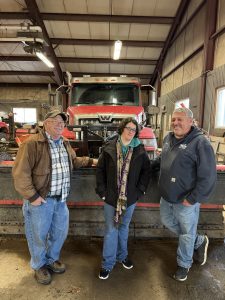
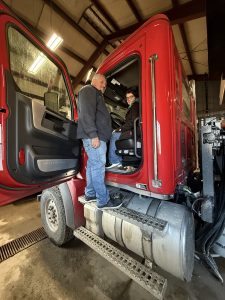
Before my first winter as City Manager, I was given a piece of advice over coffee from City Council Chair Michelle Beal, a former City Manager who understands Ellsworth not just as a place on a map, but as a living system with habits, memory, and pride.
She told me that what I would likely enjoy most about the job was not the visible work of city government — the meetings, votes, and public discussions — but the hidden machinery of the city: the water and sewer lines beneath our feet, the systems we only notice when something goes wrong, and the quiet competence that keeps daily life from unraveling. Then she paused and added, with the confidence of someone who had seen it many times before, “Wait until the first snow event. When the Pride of Ellsworth comes out, it’s something to behold.”
At the time, I nodded politely. Snowplowing is easy to underestimate. From a warm kitchen window, it looks simple enough — trucks, blades, salt, repetition. What I did not yet understand was that in Ellsworth, snowplowing is less a task than a tradition, a practiced expression of civic responsibility carried out across ninety-seven square miles of coastline, neighborhoods, back roads, and working waterfront.
I would soon learn that Michelle Beal was not speaking figuratively.
On the night before Christmas Eve, while many of us were preparing for the holidays, Ellsworth’s Public Works crews were awake and on high alert. What earlier in the week had appeared to be a minor snow event quickly became a National Weather Service winter weather advisory. Meetings were cancelled. Offices closed. And across the city, plows rolled through the night to keep roads clear and people safe.
Then New Year’s Eve approached, and once again what was supposed to be a dusting turned into the potential for another big holiday snow event. And once again the Public Works teams of Ellsworth saddled up to do the essential work that most of us take for granted.
There is a romance we often attach to snowstorms — the quiet, the beauty, the way the world briefly slows. But snow, once it commits, is not sentimental. It accumulates, hardens, and turns ordinary errands into negotiations with gravity. In Ellsworth, those negotiations are handled quietly, deliberately, and often before most of us even know we are about to have them.
Ellsworth’s size makes this no small task. At ninety-seven square miles, it is the largest municipal landmass in Maine and the second largest in New England. On paper, that scale is abstract. During a storm, it becomes very real. You feel it in the length of the plow routes, the repetition of passes, and the endurance required to keep the city moving. In winter, you often know exactly where the city line is — not by a sign, but by the condition of the road.
I have learned that lesson firsthand. Driving home during a storm, I once found Ellsworth’s roads tough but passable, the work already done. Beyond the city line, conditions deteriorated quickly. On a downhill stretch, going well below the speed limit, my car slid toward a ditch. It took the kindness of a Maine Maritime Academy student — with tow straps and patience — to get me back on the road. The contrast was unmistakable.
Municipal governments are often asked to reinvent themselves, and I have been involved in many process improvements since taking this role. Winter operations, however, are not one of them. There is nothing theoretical about snow. You either clear it or you don’t. Ellsworth has been doing this well for a very long time, and that institutional knowledge — earned storm by storm — is a form of civic wealth.
What makes the Pride of Ellsworth (The Public Works teams) remarkable is not only the plowing itself. Plowing is the most visible work, but it is only part of the story. Our Public Works crews also maintain ditches and culverts, sweep streets, repair aging water mains, and respond to emergencies in freezing, dangerous conditions. Last Christmas Eve, while managing a snowstorm, they were also called upon to repair a major water main break. Most residents never knew it happened — and that, in many ways, is the mark of excellence in public service.
During these storms, the Pride of Ellsworth extends well beyond public works. Our police officers, firefighters, and dispatchers play a critical role in keeping the city safe. Police adjust patrols and respond to weather-related accidents. Dispatchers remain alert through long overnight shifts, coordinating calls when conditions are at their worst. Firefighters prepare for increased risks, from medical emergencies to power outages, often navigating the same difficult roads they are called upon to serve. These departments operate around the clock and in close coordination, ensuring that help arrives when it is needed most.
This work is demanding, often exhausting, and rarely noticed when it goes right. When roads are clear and water runs from the tap, it is easy to forget the effort behind it. But that invisibility is the hallmark of effective public service.
As we finish gathering with family and friends this holiday season, I hope we take a moment to think about the city employees who made those gatherings possible — the plow drivers and mechanics, the police officers, firefighters, and dispatchers who worked through the night so the rest of us could enjoy a safe and peaceful Christmas morning.
That is the Pride of Ellsworth: dedicated public servants who do their best work while the rest of us sleep. On behalf of the City of Ellsworth, thank you — and Happy New Year.
Charles Pearce
City Manager, Ellsworth, Maine